
You can know a guitar so well that you start playing around its problems. You bend somewhere else. Raise the action a little. Avoid the note that always seems to give up early.
Eventually, those compromises become part of how you play. The frets deserve a closer look.
The small surface doing a big job.
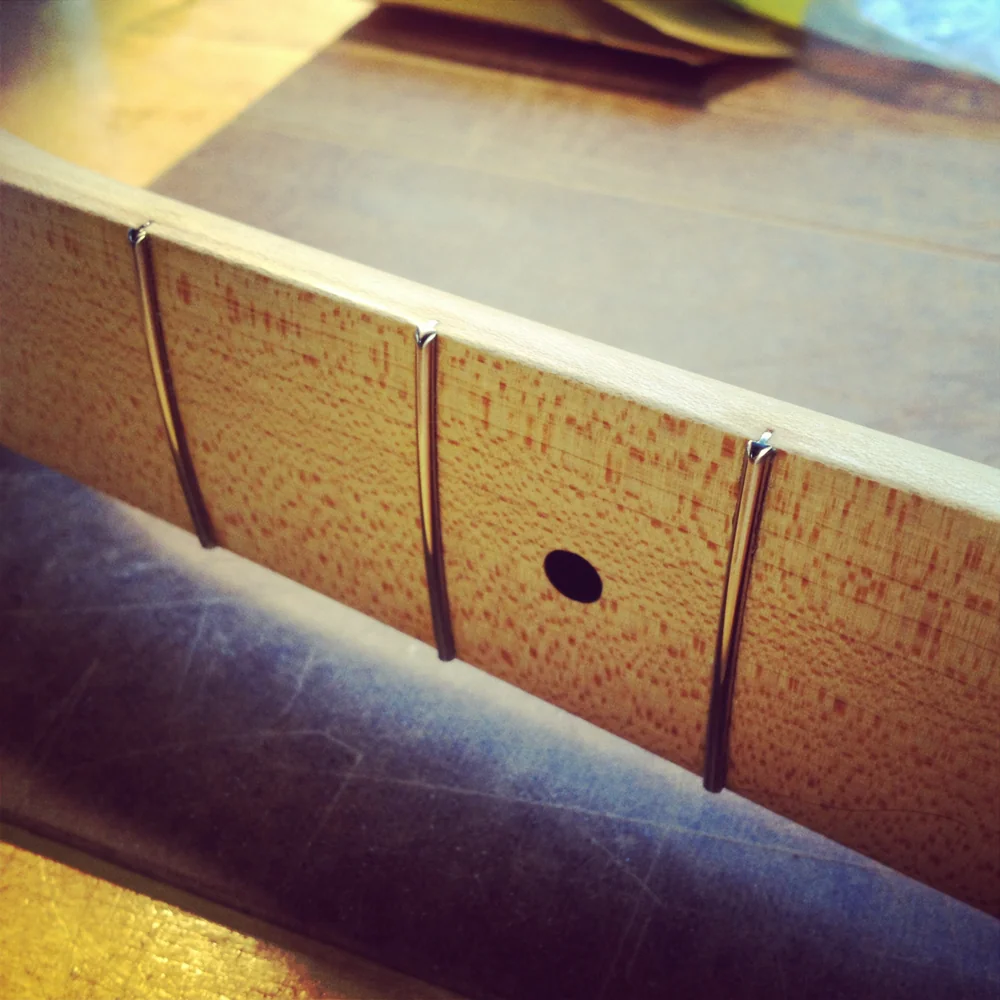
Fret a note and the crown of that fret becomes one end of the string’s speaking length. That small contact area helps define the note. Its position, shape, height, and stability all matter.
A worn groove or a broad, flattened crown changes that contact. An uneven fret farther along the neck can catch the vibrating string, adding buzz or stopping a bend short. Correcting those problems can reveal a cleaner attack and a note that rings without the same interference.
Feel is part of the sound.
A smooth, well-polished fret gives a bending string an even surface to travel over. Suitable height gives your fingertips room to control the string. Dressed ends make movement along the neck comfortable.
That changes how the instrument meets your hands. When a guitar responds predictably, it becomes easier to use the pressure, vibrato, and dynamics you intend. Those choices are audible.
Wire size is personal. Taller frets can suit a light touch and expressive bends; pressing too hard can pull notes sharp. A familiar lower profile may suit another player. We choose the dimensions around your playing and the instrument.
The fret belongs in the coupling conversation.
We often discuss coupling at the bridge or neck joint. The fret is another connection in that system: string to fret, fret to fingerboard, fingerboard to neck.
A securely seated fret provides a stable support. Its crown needs to meet the string cleanly, and the surrounding fretwork needs to leave that string room to move. Those practical details are where a refret earns its keep.
The neck also vibrates. At some frequencies, energy leaving the string through its supports can shorten a note’s decay. Research into electric-guitar dead spots measures this behavior at the frets. That is why “more coupling” alone tells us very little about whether a particular note will sustain longer. The response of the whole instrument matters. Helmut Fleischer’s measurements of dead spots explore this relationship.
A refret can address worn surfaces, poor seating, and fret-height problems. It cannot promise to remove a structural resonance or give every guitar the same voice. The goal is a reliable playing surface that lets this instrument do its job.
Choose the wire. Pay attention to the work.
Nickel silver and stainless steel both make good playing surfaces. Stainless is a useful choice when wear resistance is a priority. Crown dimensions, seating, leveling, and polish still determine much of what you feel.
Changing alloy alone gives us no reliable recipe for a brighter or warmer guitar. We start with the feel you want, the instrument’s condition, and how you use it. On a vintage guitar, preserving the board, binding, and finish belongs in that discussion too.
Sometimes the frets you have are enough.
If sufficient height remains, a level, crown, and polish may restore a useful playing surface. A refret becomes worthwhile when wear is too deep, the remaining frets are too low for the job, or a different profile would better suit the player.
The first step is an assessment. We look at the neck and frets, listen to the problem, and consider the setup as a whole. New wire works best as part of that complete job.
Keep the guitar. Lose the compromises.
A good refret gives a well-loved instrument more useful years. The familiar neck stays in your hands, with a fresh playing surface fitted to the way you want to play.
Tell us what your guitar is doing and what you wish felt different. We’ll work out whether fretwork is the next step.
Omaha, Nebraska · By appointment only. Every job is quoted before work begins.
Further reading
Artifact: Electric guitar coupling
UNSW: Strings, standing waves and harmonics
StewMac: Essential fretting tools and techniques