
Ask a player what changes their tone and you'll hear the same short list: pickups, wood, strings, amp. The bridge almost never comes up. It gets filed under hardware, the same category as strap buttons and tuner bushings, something that holds a part in place while the interesting components do the work.
But the saddle is one end of the vibrating string. The way it supports that string is part of the instrument's response. That makes the bridge worth designing with the same attention we give the neck.
What a Bridge Actually Does
The vibrating length of a string runs from the nut, or the fret you're holding down, to the saddle. Those supports are not perfectly still. Their movement affects how energy leaves the string and how the note decays.
Mechanical impedance describes how much a structure resists motion under an applied force. Mass is part of that behavior, but stiffness, damping, and frequency matter too. A heavier bridge is not automatically a better bridge. How the parts fit together matters at least as much as how much metal is on the scale.
A saddle that rocks or hardware that rattles is a practical problem we can address directly. The aim is a stable support for the string, with adjustments that stay where they are set.
What Mass Buys You
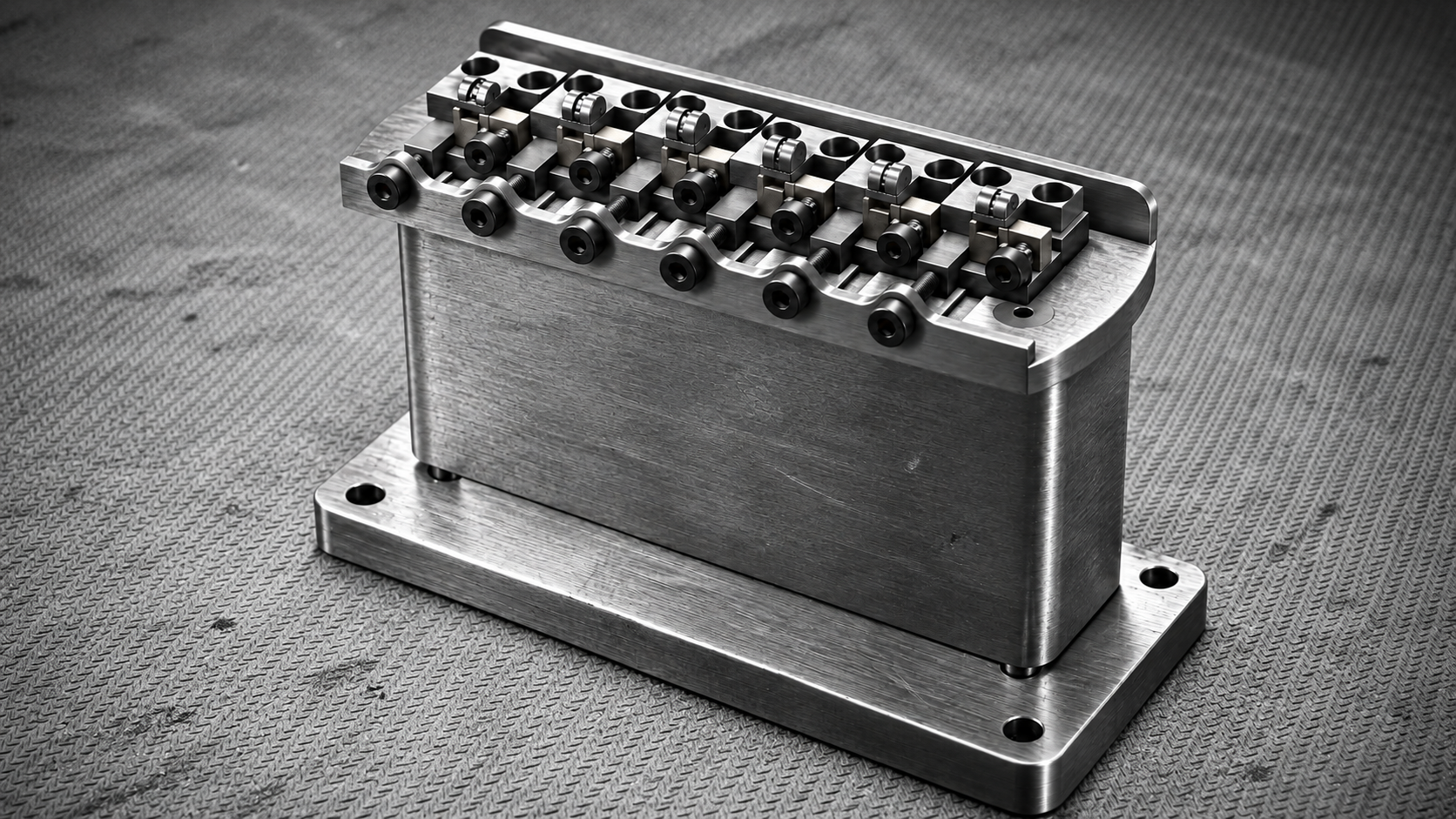
Mass gives us something useful to work with: a substantial structure beneath the saddles. In the Artifact bridge, the sustain block is part of that structure, carrying the bridge plate and moving with it when overall height is adjusted.
That does not make sustain a simple equation in which more weight always produces a longer note. Changing a bridge changes a mechanical system. The result depends on the rest of the instrument, and a claim about audible improvement needs a controlled comparison.
There is also a point where more metal becomes a burden. Balance on a strap and comfort over a long set belong in the design brief. The case for more bridge mass is a case for putting material to work where it supports the string, not adding weight for its own sake.
The Current Artifact Bridge
The current design combines six individually adjustable saddles with a bridge plate, a movable sustain block, and a rear base plate. Guide dowels keep the block aligned as its height changes. Adjustment screws establish its position; separate lock screws secure it after setup.
The distinction matters. A bridge has to move while you are setting it up. Once the setup is right, it needs to hold that geometry under string tension and the pressure of a player's hand. This design gives adjustment and locking separate jobs.
Set Each String, Then Lock the Saddle
Each saddle has its own height and intonation adjustment. A wedge mechanism changes the saddle height, so the string heights can be set to suit the fingerboard and the player's setup. The radius is established through those individual settings; it is not fixed into a set of non-adjustable saddles.
To make an adjustment, release the saddle's lock screws. Set the height, move the saddle forward or back for intonation, then tighten the locks. The animation below shows the sequence and the parts that move.
Change Overall Height From the Back
Once the individual saddles are set, the entire bridge can be raised or lowered from the back of the guitar. This lets you change overall action without starting over on all six saddle heights.
Release the two rear lock screws, then turn both adjustment screws to move the sustain block along its guide dowels. The block lifts the bridge plate and saddles together. Tightening the lock screws pulls the block down against the adjustment screws, securing the chosen height.
One 3/32-inch hex key fits all four rear screws. With the bridge moved evenly, the relative saddle heights remain as set. As with any action change, check tuning, playability, and intonation afterward.
Where the Argument Stops
The useful question is whether the assembled bridge holds its settings and provides a stable string support. Mass alone cannot answer that. Neither can a rendering or an exploded view. Those show how the mechanism works; listening and measurement are how we evaluate its behavior on an instrument.
The bridge is also only one end of the string. A short-lived note is not proof of a bridge fault. Research on solid-body electric instruments has linked dead spots to neck resonances, where energy leaves the string through its support at the neck. Replacing a bridge is not a universal cure for that behavior.1
What to Listen For
Play familiar passages with a clean sound and listen beyond the attack. Follow the decay of a single note, then play across the neck. If something buzzes or a note stops abruptly, investigate the setup and the instrument as a whole before assigning the cause to one component.
When comparing bridges, keep strings and setup as consistent as possible. Use the same pickup settings and signal chain. A change in action or pickup height can complicate what seems like a straightforward comparison.
Pay attention to the bridge under your hand, too. It should feel secure when you palm mute, and the settings should remain stable after playing. Those are everyday requirements, not secondary details.
That is what this bridge is designed around: enough structure to support the string, with a setup you can adjust precisely and then secure.
1 Helmut Fleischer, “Dead Spots of Electric Guitars and Basses,” Acoustical Society of America, 1999. Background on string decay and neck resonances; not a test of the Artifact bridge.